


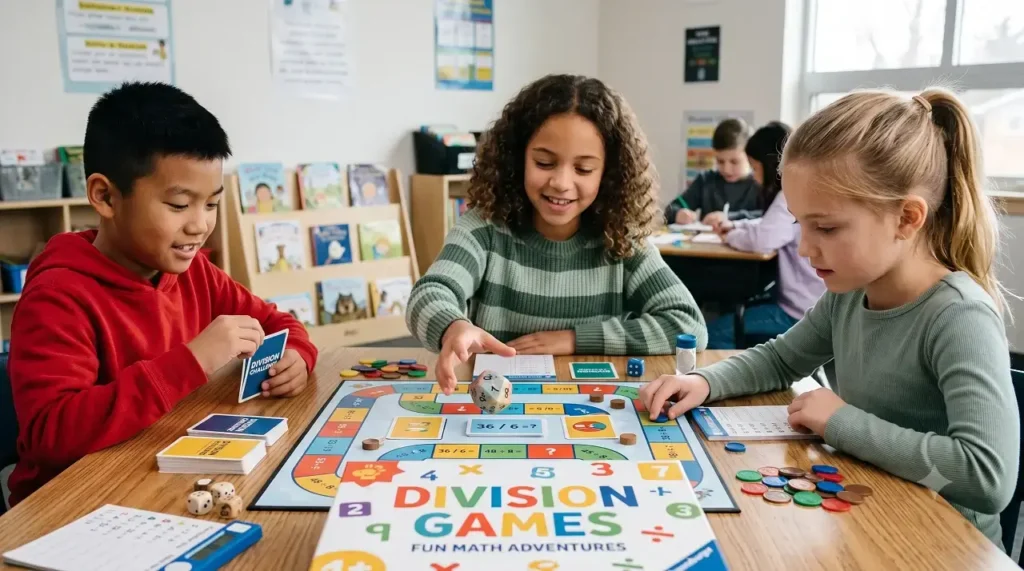
Division gets easier when your child can see it, play it, and use it in real situations. The right Division Games make learning more interactive and enjoyable for kids. Instead of repeating worksheets, children can practice division through fun challenges. This keeps them engaged while building confidence and stronger math skills.
Key Highlights
- Division games help children practise sharing, grouping, multiplication facts, quotients, remainders, and mental maths.
- Free browser-based options can provide quick practice without requiring a paid subscription.
- Current online resources include activities for Grades 3, 4, 5, and beyond, including division facts, remainders, patterns, and long division.
- The Education Endowment Foundation says well-designed maths games can create repeated practice while encouraging children to discuss strategies and mathematical ideas.
- Short sessions of 5 to 15 minutes often work better than forcing a child through a long worksheet.
- You can mix online division games, classroom activities, printable worksheets, cards, dice, and everyday objects for a balanced learning routine.
What Are the Top Apps and Software for Division Games?

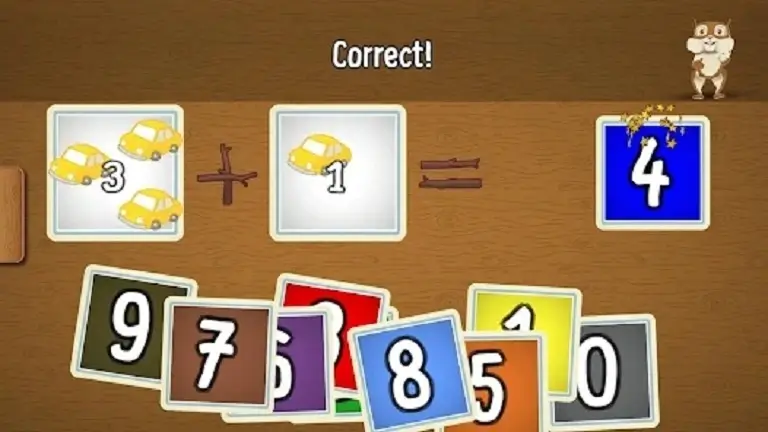
A good division app should do more than throw random questions at your child. Look for clear explanations, sensible difficulty levels, immediate feedback, progress tracking, and practice that connects division to multiplication. That last point matters because division is closely linked to multiplication. For example, once a child understands that 6 × 4 = 24, the related facts 24 ÷ 6 = 4 and 24 ÷ 4 = 6 become much easier to understand. Current free resources such as KidsDoMath use this fact-family approach and cover division facts connected to multiplication tables through 12.
For younger learners, avoid choosing an app simply because it looks exciting. A game with flashing graphics and fast timers may keep a child busy without helping them understand why an answer is correct. From a teaching point of view, the better choice is an activity that gives your child a chance to explain the answer, try another strategy, and repeat difficult facts. That matches the Education Endowment Foundation’s guidance that the purpose of a maths game should be considered carefully rather than treating games as entertainment alone.
Which Are the Best Division Game Apps for Kids?
When choosing division game apps for kids, focus on your child’s grade level and current math skills rather than simply choosing the most popular app. A Grade 3 learner practising basic division facts will need a different type of activity from a Grade 5 learner working on remainders or long division.
- Choose by grade level: Look for division games that match your child’s current learning stage.
- Check the division skills covered: Math Games currently offers activities for different grade levels, including: Division with divisors up to 10, Division patterns, Remainders, Other division-related skills
- Consider the curriculum: The India-facing Math Games site also includes activities designed around the India Mathematics Curriculum.
- Check device compatibility: Make sure the app works smoothly on the device your child already uses.
- Look for simple instructions: Children can learn more easily when game instructions are clear and age-appropriate.
- Watch for unnecessary purchases: Choose apps that allow meaningful practice without requiring constant in-app purchases.
- Consider language needs: If your child struggles with English-heavy explanations, a simple, number-focused interface may be easier to use.
- Connect games with real-life examples: Reinforce division using familiar situations, such as: Sharing 24 biscuits among 6 children, Dividing ₹100 equally among 5 people, Arranging 30 pencils into equal groups
What Are the Best Free Division Game Apps for Android?
Free division practice can be surprisingly useful when you choose carefully. Math Master: Multiply & Divide, for example, currently offers multiplication and division practice, multiple difficulty modes, local progress saving, offline core practice, and printable worksheet generation. Its Google Play listing says core multiplication and division practice is available without a subscription.
Another useful option is a browser-based tool rather than a traditional Android installation. KidsDoMath says its division practice is free, has no ads or sign-up, works offline as a Progressive Web App, and covers division facts derived from tables 1 through 12. This kind of option can be handy when you want your child to practise for a few minutes without creating another account. Before installing any children’s app, check the developer, permissions, advertising model, age suitability, and recent reviews.
How Can You Download Safe and Fun Division Games for Tablets?
Safety should come before fancy graphics. Use the official app store on the tablet, check the publisher name, read the privacy information, and avoid downloading APK files from unknown websites. For younger children, it is also sensible to review whether the app includes external links, chat features, advertising, purchases, or unnecessary access to device information.
Browser games can reduce installation work altogether. Math Games, for example, states that many of its division activities are compatible with phones and tablets, while KidsDoMath provides browser-based practice. A simple rule works well at home: if you would not be comfortable letting your child explore the app without you standing beside them, it probably needs another look before becoming part of the regular learning routine.
How Should You Review Popular Division Learning Software for Children?
Think of a division app like a bicycle. The graphics are the paint, but the learning design is the frame, wheels, and brakes. Before you choose, check whether the software teaches the meaning of division, provides enough repetition, increases difficulty gradually, and lets children practise mistakes instead of simply moving on.
| Feature | What to look for | Why it matters |
|---|---|---|
| Difficulty levels | Beginner to advanced | Prevents frustration |
| Feedback | Explains or supports mistakes | Builds understanding |
| Fact practice | Divisors such as 2 to 12 | Develops fluency |
| Remainders | Increasing challenge | Prepares for harder problems |
| Progress tracking | Results and mistakes | Helps parents monitor practice |
| Offline access | Practice without constant internet | Useful for travel |
| Ads and purchases | Clear and limited | Better family experience |
A useful current example is Num Drill, which describes six progressive levels from basic division facts through long division and uses adaptive review to revisit difficult facts. That progression is more useful than simply giving every child the same set of 50 questions.
What Are the Top-Rated Division Games for Kids to Play on Mobile?

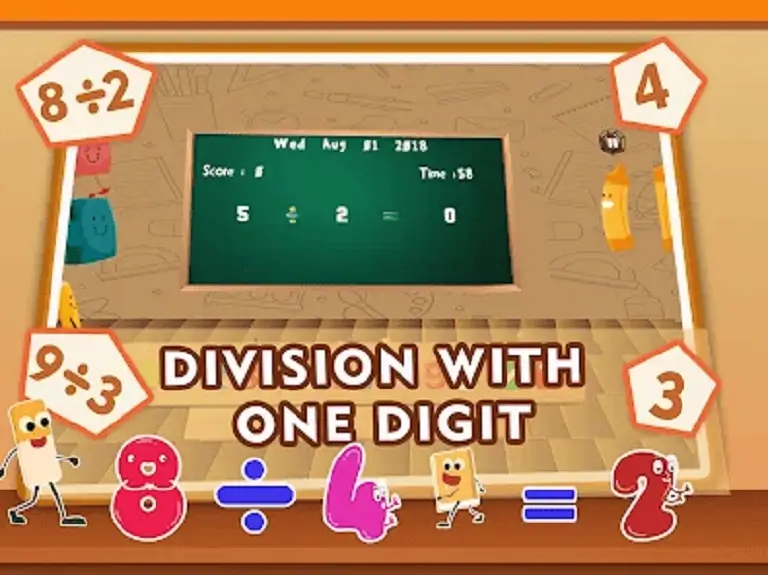
For mobile practice, short sessions often work better than asking a child to sit through a long digital lesson. Try five to ten minutes of focused practice, then stop while the activity is still enjoyable. Hit the Button works particularly well for this format because many activities are designed as quick-fire challenges, while its app also offers untimed practice. Topmarks says the app contains 166 maths game modes across six topics, including division, multiplication, number bonds, doubles, halves, and square numbers.
You can also use mobile games as a warm-up before deeper maths. Ask your child to play a few division rounds, then put the device away and give them a real problem. For example, after practising division by 4, ask: “There are 32 pencils. If four children share them equally, how many pencils does each child receive?” The screen gives you speed practice, while the real-world question checks understanding. That combination is much more useful than chasing a high score for its own sake.
Where Can You Play Division Games Online?
Online division games give you a huge advantage: variety. If your child is bored with one activity, you can switch from a timed quiz to a matching game, a grouping puzzle, a number fact activity, or a written division challenge. Topmarks currently separates maths games by age group, including 5 to 7 and 7 to 11, which makes it easier to find an appropriate starting point.
The key is to choose the game based on the skill, not the theme. A space game may look exciting, but if it only asks questions your child already knows, it will not stretch them. Likewise, a difficult game can create frustration if the child has not learned the multiplication facts needed to solve the division problems. Think of online games as tools in a toolbox. Pick the tool that fixes today’s learning problem.
Which Are the Best Platforms to Play Division Games Online?
Topmarks is one of the strongest places to begin because its multiplication and division section includes a range of activities rather than one single game. Children can practise quick recall with Hit the Button, explore mathematical vocabulary with Mental Maths Train, work with fact families, and try more direct division activities such as Demolition Division.
Wordwall is another useful option, especially for teachers and parents who want to create custom activities. Its current division collection includes formats such as matching pairs, quizzes, flashcards, maze chase, balloon pop, open the box, and equal-groups activities. Wordwall also allows activities to be played digitally or printed, which makes it easy to move from screen practice to paper practice.
Where Can You Find Online Division Practice Games for Primary Students?
Start with the age or grade level, then narrow the activity by skill. For a child beginning division, look for equal groups and sharing. Once that idea is secure, move toward division facts and fact families. Later, add remainders, two-digit division, word problems, and formal written methods.
Topmarks has division resources for different primary age ranges. Its Year 5 division worksheets, for example, include short division with remainders, divisors up to 12, multiplication and division by 10 and 100, missing signs, factors, multiples, and word problems. This progression matters because division is not one single skill. A child might understand sharing 20 counters into 5 groups but still struggle with 156 ÷ 12 on paper.
Which Division Games Are Highly Engaging for 3rd Graders?
Third graders often sit at an important point in maths learning. They are moving from physical ideas such as sharing objects toward faster recall of multiplication and division facts. That makes games based on equal groups, fact families, missing numbers, and simple word problems especially useful.
Try a “Mystery Number” game. Write “My number divided by 4 equals 6” and ask your child to find the mystery number. The answer is 24, but the real learning comes when you ask them to prove it using multiplication. Number Fact Families are particularly helpful because they connect multiplication and division, showing relationships such as 4 × 6 = 24 and 24 ÷ 6 = 4. Topmarks’ Number Fact Families activity uses three numbers to build related multiplication and division facts and is aimed at children around ages 6 to 11.
What Educational Websites Offer Interactive Division Activities?
A strong educational website should do more than turn a worksheet into a colourful screen. Look for activities that make children think, choose, explain, compare, or solve. Good interaction has a purpose. Dragging objects into equal groups can reinforce the meaning of division, while selecting the correct answer repeatedly can help develop fact fluency.
Topmarks provides both direct games and teaching resources. Its division collection includes Grouping, which demonstrates division by grouping objects and can include versions with or without remainders. It also includes Fair Shares, which introduces the idea of sharing small amounts equally. These are valuable examples because they connect the written symbol to something a child can picture.
How Do You Find the Best “Cool Math Games” for Division Practice?
When you search for cool math games for division, do not choose a game simply because it has a fun title. Read the description and identify exactly what the child will practise. Is it division facts? Remainders? Factors? Long division? Word problems? Mental arithmetic? The answer tells you whether the game belongs in today’s lesson.
A quick checklist can save you time:
- Check the age or grade level.
- Identify the exact division skill.
- See whether the difficulty can increase.
- Check if mistakes receive useful feedback.
- Avoid relying only on timed questions.
- Look for activities that connect multiplication and division.
- Test the game yourself before giving it to a younger child.
That last step is often overlooked. Spend two minutes playing the game yourself. You will quickly see whether the questions match your child’s level, whether the controls are easy, and whether the activity actually teaches maths.
Which Multiplication and Division Games Should You Try?

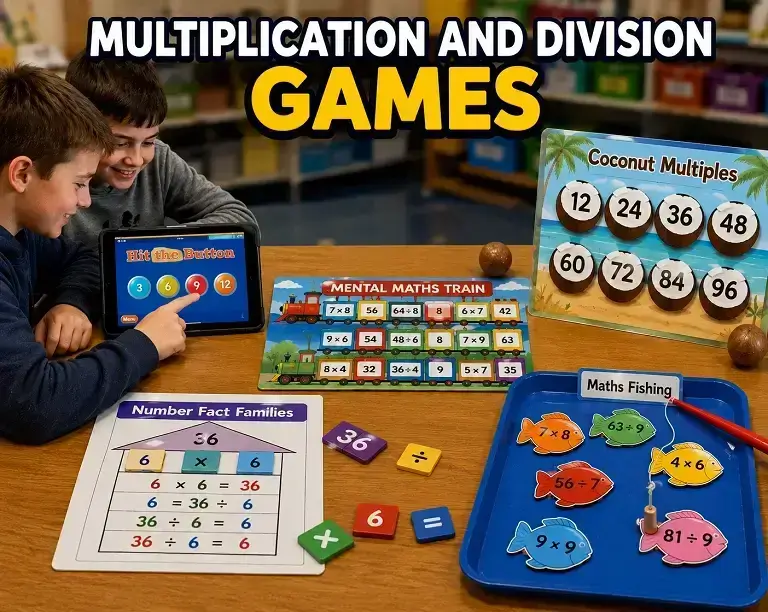
f you want to make multiplication and division practice more enjoyable, these games turn basic number facts into quick, interactive challenges. They are easy to play and can help you build speed, accuracy, and confidence without making practice feel like repetitive homework.
- Hit the Button — This fast-paced game challenges you to answer multiplication and division questions before the timer runs out. It is a great choice when you want to sharpen your mental maths skills while keeping the activity exciting.
- Mental Maths Train — Hop aboard the Mental Maths Train and solve number questions as you move through the game. It gives you a fun way to practise calculations and improve your ability to work with numbers quickly.
- Coconut Multiples — In Coconut Multiples, you identify the correct multiples while avoiding the wrong answers. The simple gameplay makes it especially useful for practising multiplication tables and recognising number patterns.
- Number Fact Families — This game helps you see the connection between multiplication and division through related number facts. It is useful for understanding how the two operations work together instead of simply memorising answers.
- Maths Fishing — Cast your line and catch the correct answers to maths questions in this playful activity. It combines a simple fishing theme with multiplication and division practice, making number work feel more like a game.
How Can You Create Fun Division Quizzes Using Wordwall?
Wordwall can be especially useful when you want a division activity that matches your child’s exact level. Its community collection currently contains division games in formats such as find the match, maze chase, quizzes, flashcards, matching pairs, balloon pop, open the box, and word problems. Wordwall also says you can choose a template, enter your own content, and create interactive or printable activities.
For example, you could create ten questions around division by 3:
- 12 ÷ 3 = ?
- 15 ÷ 3 = ?
- 18 ÷ 3 = ?
- 21 ÷ 3 = ?
- 24 ÷ 3 = ?
Then add a few reverse questions such as “3 × ? = 18.” This small change matters because it forces the learner to move between multiplication and division instead of memorising one pattern. For classroom use, you can turn the same questions into a quiz, matching game, or printed card activity.
How Much Do Affordable Subscription Services for Division Games Cost?
You do not need a paid subscription to begin teaching division through games. Plenty of useful practice is available through free educational websites, classroom-created activities, and simple homemade games. Paid platforms can be worthwhile when they provide structured lessons, progress tracking, adaptive difficulty, teacher reports, or a large library that you will use regularly.
The smart question is not “Which subscription is cheapest?” It is “What will my child actually use?” If a £5 or £10 resource is opened twice and forgotten, it is not a bargain. On the other hand, a resource that becomes part of a weekly learning routine can offer good value. Compare the content, device support, advertisements, offline access, progress tracking, parental controls, cancellation terms, and curriculum fit before paying.
What Are the Best Offline, Classroom, and Easy-to-Play Division Options?
Digital games are useful, but you can teach division without a screen. In fact, physical objects can make the idea easier to understand for children who are still developing number sense. The Education Endowment Foundation highlights the purposeful use of manipulatives and representations as part of approaches aligned with high-quality maths teaching.
Try buttons, LEGO bricks, bottle caps, coins, pencils, cards, or small pieces of fruit. Give your child 24 objects and ask them to make 6 equal groups. Then change the question: “Can you make groups of 4?” The numbers have stayed the same, but the divisor has changed, helping your child see what division really does.
What Are Fun and Interactive Division Games for the Classroom?
A classroom division game should be easy to explain and quick to reset. Division Bingo works well because students solve problems and mark the matching answer. A division card race can ask pairs of students to match equations with answers. A grouping challenge can use counters, where each team has to show a division equation with a given number of objects.
You can also run a “Which Doesn’t Belong?” activity. Put four equations on the board, such as 20 ÷ 5, 18 ÷ 3, 16 ÷ 4, and 15 ÷ 4. Ask students to identify the odd one and explain why. The answer is not simply about calculation, because 15 ÷ 4 has a remainder while the others divide evenly. That small discussion creates mathematical language and gives the teacher a chance to hear how students are thinking.
How Can You Play Division Games on Smartphones Easily?
Keep smartphone practice simple. Open a trusted browser-based game, bookmark it, turn off unnecessary notifications, and set a short practice period. If you are using a dedicated app, check that it works on your device and review its privacy and purchase settings first.
For younger children, sit nearby during the first few sessions. You do not need to solve every question for them. Instead, ask prompts such as “What multiplication fact could help you?” or “Can you draw the groups?” This keeps the phone from becoming an answer machine. A good habit is play, explain, apply: play a short game, explain one difficult problem, then apply the same idea to a real-life question.
How Can Downloadable Division Worksheets Feel Like Games?
Worksheets do not have to look like a wall of calculations. Turn them into missions, treasure hunts, detective puzzles, or board games. For example, each correct division answer can reveal a letter, and the letters can form a secret word. You can also create a path where each square contains a division problem, with players moving forward after solving it.
Topmarks currently offers division worksheets covering skills such as short division, remainders, division by 10 and 100, factors, multiples, and word problems. Use those resources as practice material, then add a simple game layer around them. The maths stays the same, but the experience becomes more active.
What Fun Everyday Offline Activities Can Teach Division?
Your kitchen, living room, and shopping bag can become division classrooms. Share 12 grapes equally among 3 people. Arrange 20 socks into 4 piles. Divide 30 crayons among 5 children. Ask your child to predict the answer before physically making the groups.
You can also use money for practical problems. If five identical notebooks cost ₹200 in total, ask how much one notebook costs. If ₹500 is shared equally between four people, what happens to the remainder? These examples show children why division matters outside a maths book.
The best part is that you can ask follow-up questions without preparing anything. “How do you know?” “Can you solve it another way?” “What multiplication fact proves your answer?” Those questions build mathematical reasoning while keeping the activity relaxed.
What Type of Games Are Best for Learning Division?
The best division games are the ones that match the learning goal. If your child needs basic fact fluency, use quick recall games. If they don’t understand what division means, use grouping and sharing games. If they are learning remainders, use real-life problems where the leftovers actually matter.
A balanced practice plan might look like this:
| Game type | Best for | Example |
|---|---|---|
| Fact-family games | Multiplication and division links | 6 × 4 = 24 |
| Card games | Fact fluency | Draw two cards and divide |
| Dice games | Mental maths | Roll for dividend and divisor |
| Bingo | Recall | Match quotients |
| Grouping games | Conceptual understanding | Share 24 objects |
| Word problems | Real-life reasoning | Share 30 items among 5 |
| Digital games | Repetition and feedback | Timed or untimed practice |
| Relay games | Classroom engagement | Teams solve question cards |
| Worksheet games | Independent review | Cut, sort, and solve cards |
Research supports the idea that purposeful maths games can have a useful role in learning. The EEF says games can provide repeated practice and mathematical discussion, while its evidence review on early numeracy rates early numeracy approaches at +7 months of progress, with the important caveat that the evidence base is limited
Verdict
Division games work best when they make children think, explain, practise, and apply. Start with equal sharing and grouping if your child is new to division. Move into multiplication and division fact families as their confidence grows, then add remainders, word problems, and written division. For online practice, Topmarks offers a strong range of age-based activities, while Wordwall is useful when you want customizable quizzes and printable or interactive formats.
You also do not need an expensive setup. A tablet, a trusted website, ten counters, a deck of cards, or a handful of everyday objects can all become useful teaching tools. The most important part is choosing the right challenge. If your child already knows 20 ÷ 5, give them something that makes them reason, such as 23 ÷ 5 with a remainder or a real-world sharing problem.
For families, the simplest routine is often the most sustainable: 5 to 10 minutes of game practice, one discussion about a tricky question, and one real-life division problem. That small routine can turn division from a frustrating school topic into something your child can actually see, explain, and use.
FAQS
How do you explain the division game?
Explain division as sharing or grouping. For example, if you have 12 candies and want to share them equally among 3 children, each child receives 4. Then connect the story to 12 ÷ 3 = 4 and check it with 3 × 4 = 12.
Can you give me an example of division?
A simple example is 20 ÷ 5 = 4. You can explain it by saying that 20 objects are placed into 5 equal groups, giving each group 4 objects.
What are some division games?
Try Division Bingo, fact-family cards, dice division, division races, matching games, digital division games, grouping challenges, and classroom relay games. Choose the activity according to whether your child needs concept practice, fact fluency, remainders, or problem solving.
What are some fun activities to teach division?
Use snacks, toys, pencils, coins, cards, dice, paper plates, and household objects. Ask your child to divide 24 objects into 2, 3, 4, 6, or 8 equal groups. You can then turn each answer into a multiplication fact.
What are some good division activities for Grade 5 students?
Grade 5 students can practise multi-digit division, remainders, division patterns, missing-number problems, word problems, fractions, and decimal division. Current Math Games resources include Grade 5 activities covering remainders, division patterns, and division involving larger numbers.
Is the division or Division 2 better?
If you mean the video games Division and The Division 2, neither is a division maths game. They are action video games made for a very different audience. If you’re asking about learning division, choose a maths game that directly practises sharing, grouping, quotients, multiplication facts, or remainders.